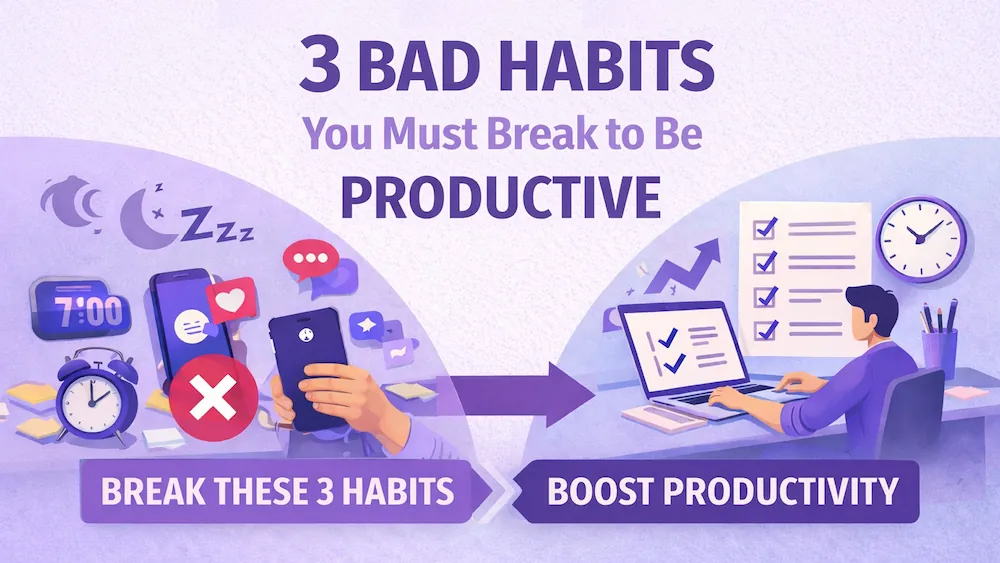
In our fast-paced world, productivity is essential to success. Yet, we all face bad habits that hinder our progress and prevent us from reaching our full potential. Breaking these habits is crucial for staying focused, achieving our goals, and living a fulfilling life.
In this blog, I’ll share the 3 bad habits you must break to be productive. For each, we’ll explore actionable steps you can take to break free and become the productive person you aspire to be.
Bad Habit #1/ Procrastination: The Enemy Within
Have you ever noticed that the time we spend avoiding or delaying a task often ends up being longer than the time it would actually take to complete it?
Procrastination is one of the worst habits we can have, and it’s something we’ve all been guilty of. Take today, for example: I missed the gym. At first, I tried to figure out why was it bad sleep, poor food choices, or lack of time? None of these reasons made sense. I had slept well, eaten right, and even woke up early at 6 AM. But then, I remembered the voice.
The Inner Enemy
At 6 AM, when my alarm went off, instead of jumping out of bed, I listened to that voice inside me:
“Hey buddy, it’s too early. Let’s take a 10-minute nap. You can still go at 6:10.”
I snoozed the alarm. When 6:10 came, the voice whispered again:
“We’re not running late. Another 10 minutes won’t hurt. You deserve the rest it’s good for muscle recovery, remember?”
Before I knew it, it was 7:30 AM. By then, my brother called, needing help to shift a cupboard at night. The voice seized the opportunity:
“See? We’ll be busy later. Let’s skip the gym and rest now. It’s the smart thing to do.”
And just like that, I gave in.
The Hard Truth
As I write this, it’s tempting to blame my brother or the circumstances for breaking my gym streak. But the truth is, the real culprit was me. That voice wasn’t some external force. It was my own inner consciousness the enemy who knows me too well. It understands my weaknesses, fears, and exactly what to say to make me give up.
The Constant Battle
This battle isn’t limited to the gym. That voice shows up everywhere whether it’s in my decisions about food, work, learning, or life in general. It’s always there, whispering excuses, rationalizing delays, and holding me back. The worst part? It’s a battle I can’t escape because this enemy lives within me.
Ways to Stop Procrastination
I’ve realized that there are two main reasons why procrastination creeps in for me: either I’m unclear about the action, or the action seems too huge to consider.
Action Is Too Huge to Consider
For example, my gym routine is quite robust it spans over 2 hours of intense work. Naturally, my brain tries to avoid it, almost like a survival instinct to conserve energy. To tackle this, I use the 5-Minute Rule. Instead of focusing on the entire gym routine, I tell myself, “I’ll focus only on getting out of the house and into my gym clothes within the first 5 minutes of waking up.”
This simple shift has helped me tremendously. Once I’m out of the house in my gym suit, I almost always end up going to the gym and completing the workout. The key is taking that first small step.
Unclear About the Action
I faced another instance when I had delayed a development project for over a month because I couldn’t figure out the entire plan. I was waiting for the “perfect plan,” but as usual, perfection didn’t come, and I ended up procrastinating.
To overcome this, I applied the same 5-Minute Rule but combined it with time-blocking. I dedicated 2 hours of my day to the development work, no matter what. Once I started the session, I committed to taking action for at least 5 minutes.
What I realized was that as soon as I started, things began to unfold automatically. When I first started coding, I didn’t have the whole structure mapped out. But as I tackled the first part, the next step became clear. This momentum allowed me to finish the project much faster than I expected.
Bad Habit #2/ Goal Switching: The Killer of Focus
Are you working towards your goals with purpose, or are you just crossing things off your to-do list without making real progress? After procrastination, goal switching (or multitasking) is the second biggest reason we don’t get things done.
I’ve spent way too many hours chasing after “shiny objects.” Every time I’d set a goal, make a plan, and start working, something new would catch my attention. Before I knew it, I was juggling 10 different goals, and none of them were moving forward. It almost felt like it would have been better not to start at all.
Why Do We Switch Goals?
We switch goals because of borrowed conviction. Often, we aren’t even chasing goals that are truly ours. We pick goals based on what others are doing, or because we start doubting our first goal and look for something else just in case. Instead of staying focused, we keep adding new goals, thinking we’re increasing our chances of success. But in reality, we’re just spreading ourselves too thin and getting nowhere.
The Trap of Sunk Cost Bias
But even when we know we’re switching too often, why do we keep at it? It’s because of sink cost bias. We’ve already spent time, energy, and resources on a goal, and it feels like quitting means all that effort was wasted. So we keep going, even if it’s not working, because we don’t want to “lose” what we’ve already invested. This leads to burnout and exhaustion, because we’re not making any real progress.
Why You’re Not Making Real Progress
As we take on more goals, our brain tries to trick us into thinking we’re making progress. It leads us to do fake tasks tasks that seem related to our goals but don’t require much effort. These tasks make us feel busy, but they don’t really help us achieve our bigger objectives. The important tasks, the ones that matter most, are often harder, so we avoid them.
How to Stop Goal Switching
The solution to goal switching is simple, but not always easy: clarity. You need to decide what truly matters to you. What aligns with your core values and long-term vision? Once you have clarity, commit to it. It’s easy to get distracted by other goals or opportunities, but if they don’t support your bigger purpose, they’ll only scatter your focus and energy.
Here’s a helpful framework to guide you: the DATA framework, which I discuss in my blog Stay Focused on Your Goals with the 4-Step DATA Framework. This framework helps you stay anchored to your most important goals and avoid the distractions that come with switching focus.
In conclusion, the key to achieving your goals isn’t about doing more, it’s about doing the right things with focus and consistency. Get clear on what matters, align your actions with that clarity, and commit to seeing it through. Only then can you break the cycle of goal switching and start making real, lasting progress.
Bad Habit #3/ Impulsive Actions: The Distraction Trap
Do you really want to drain your energy by arguing with someone, or would you rather stay focused and on track? After procrastination and goal switching, the third monster you need to face is impulsive actions. These are the moments when you allow yourself to be pulled into distractions and battles that aren’t even yours to fight. Instead of focusing on what truly matters, you lose your precious energy in arguments, debates, and situations that don’t contribute to your long-term goals. It’s like fighting a battle where the only loser is you.
At one point, I allowed myself to be heavily influenced by external factors circumstances, people, and outcomes. But over time, I realized that true fulfillment comes from within. Conquering the inner self brings clarity and a purposeful vision for life.
One of the most profound lessons I’ve learned is that while we cannot control every circumstance or outcome, we can control how we feel and how we react. Life often tempts us to respond impulsively, but it’s essential to pause, reflect, and think rationally. When we do, we realize that most things are not worth a reaction especially when viewed from a longer time frame.
Controlling the Controllable
Take this example: If someone tries to provoke you with abuse or anger, your immediate reaction might be to retaliate. But in doing so, you’ve handed over control to that person. Instead, ask yourself a simple question:
“Will engaging in this situation help me achieve my goals or align with my purpose?”
If the answer is no, the best course of action is to disengage and conserve your energy for things that truly matter.
The concept of controlling the controllables is a guide for life. It reminds us to make decisions with the understanding that not everything is within our power and it never will be. But we can always control ourselves, our reactions, and our energy. This shift in mindset not only keeps us aligned with our desired outcomes but also protects us from falling into the trap of blaming others for our choices.
Pick Your Fights
Giving away the power to external factors or people is like surrendering ownership of your life. The real strength lies in mastering your responses and channeling your focus toward what truly matters.
Ask yourself: Is this fight worth it? You have limited energy and time, and you need to be strategic in choosing where to direct your efforts. Often, responding to every provocation only drains you and takes you off course from your true goals.
The Art of Letting Go
There’s a powerful freedom in letting go. Learning to detach yourself from unnecessary battles and distractions allows you to conserve your energy for the things that truly matter. Sometimes, the best course of action is simply to walk away without reacting or engaging.
How to Implement This in Your Life
Whenever you face a situation where things don’t go as expected, resist the urge to react immediately. Instead, follow this simple technique:
- Take a 1-Minute Timeout: Pause and ask yourself: “Will engaging in this situation help me achieve my goals or align with my purpose?” If the answer is No, it’s better to find a way to move on.
- Learn to Let Go: Getting out of such situations often means not giving any response even if it feels like you’re losing, failing, or getting rejected. While this may seem counterintuitive, it saves you precious time, effort, and mental energy. These are far more valuable when focused on what truly matters in your life.
Frequently Asked Questions
What is the best way to overcome procrastination?
Start with small, manageable steps using techniques like the 5-Minute Rule. Breaking your task into smaller actions helps you focus on starting rather than finishing. For more insights, check out 5 Powerful Steps to Overcome Analysis Paralysis Today.
How can I avoid switching between multiple goals?
Gain clarity on your priorities by aligning your goals with your long-term vision. Use frameworks like the DATA method to stay focused and avoid distractions from “shiny objects.” Learn more about staying focused with the 4-Step DATA Framework.
Why is it important to resist impulsive actions?
Impulsive actions drain your energy and distract you from your primary goals. By pausing and evaluating whether a response aligns with your purpose, you can conserve energy for meaningful tasks. Stay focused on what matters by implementing strategies from 5 Steps to Turn Your Ideas Into Reality.
How do I let go of unnecessary battles or distractions?
Ask yourself, “Does engaging in this situation help me achieve my goals?” If the answer is no, practice detachment by walking away and redirecting your energy to more productive activities. Enhance your productivity by exploring 5 Powerful Steps to Overcome Analysis Paralysis Today.
What is the role of the inner voice in productivity?
Consistency comes from creating routines, staying accountable, and rewarding yourself for small wins. Focus on progress, not perfection, and remember that breaking bad habits takes time and perseverance. Learn how to implement actionable strategies in 5 Steps to Turn Your Ideas Into Reality.
Final Thoughts On 3 Bad Habits You Must Break to Be Productive
Breaking bad habits is not an overnight process, but it is a journey worth embarking on. By addressing procrastination, staying focused on singular goals, and resisting impulsive distractions, you can regain control over your time, energy, and productivity. Remember, the key to success lies in small, consistent actions. Prioritize clarity, build momentum, and learn to let go of what doesn’t serve your purpose. As you implement these strategies, you’ll find yourself not only achieving your goals but also living a more balanced and fulfilling life.